News
New Insights into the Enigma of Transposable Element Abundance in Arabidopsis
A recent comprehensive review summarizes the key factors driving transposable element (TE) abundance enigma in Arabidopsis and offers new insights and new directions for future research in the field.
Published in Trends in Genetics by Prof. GUO Yalong from the Institute of Botany of Chinese Academy of Sciences (IBCAS), the review begins by highlighting the "double-edged sword" nature of TE transposition, emphasizing that TEs can both facilitate adaptive evolution and exert deleterious effects on the host. It then discusses the evolutionary factors that could explain variation in TE abundance, followed by a summary of how genetic, epigenetic, and environmental factors regulate TE silencing and activation, ultimately leading to TE abundance variation.
The review also turns its focuses on TEs that can manage to escape host repression and become reactivated - referred to as active TEs. As one of the major drivers to TE abundance variation, active TEs are systematically characterized in the article, with an in-depth discussion of approaches for their identification and potential future applications.
"This review addresses a fundamental question in TE biology - why TE abundance varies across species, populations, and individuals, and systematically discussed the mechanisms underlying this enigma from multiple perspectives", said Prof. GUO Yalong, corresponding author of this review. "At a time when TE research is becoming more function-oriented, this work remains committed to, and further deepens, the exploration of the field's most fundamental question: the factors driving TE abundance variation".
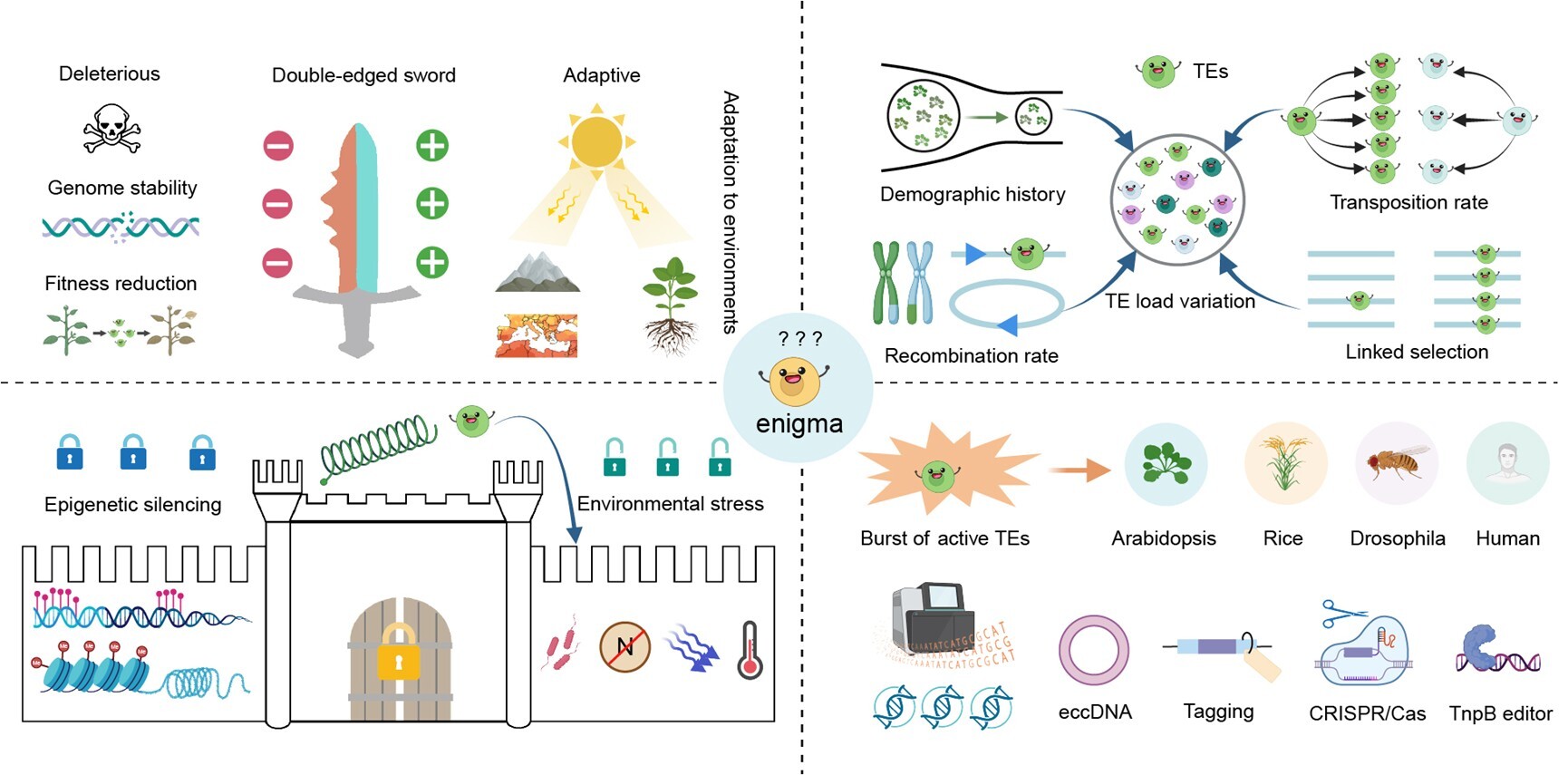
Factors contributed to TE abundance enigma (Image by YANG Longlong)