News
Chinese Scientists Reveal the Response of Plant Diversity to Climate Change Over the Past 14000 Years in the Hengduan Mountains
A new study published in Palaeogeography, Palaeoclimatology, Palaeoecology, has revealed a complex response of plant diversity to climate warming during the past 14000 years in the Hengduan Mountains of southwestern China, one of the world's foremost biodiversity hotspots.
Led by Prof. WANG Yufei from the Institute of Botany of the Chinese Academy of Sciences, along with an international collaborator from Austria, the researchers conducted interdisciplinary analyses including pollen, grain size, and loss-on-ignition from a 170 cm-deep soil section from the southern slope (elevation: 3000 m above sea level) of the Jade Dragon Snow Mountain, within the southeastern Hengduan Mountains.
They found that three natural warming events (i.e., the Bølling-Allerød warm period, the end of the Younger Dryas event, and the Holocene Climatic Optimum) did not lead to a linear increase in plant diversity and the fluctuations of diversity indices (including Simpson, Shannon-Weiner, rarefied richness and evenness) were not completely synchronous. Moreover, the study also revealed that climate warming affected the composition of taxa in the communities and further modified the vegetation structure.
This work offers a scientific basis for biodiversity conservation and sustainable development in the montane regions of southwestern China under future warming scenarios, and also serves as a valuable reference for examining deep-time plant diversity responses to climate warming in similar montane ecosystems worldwide.
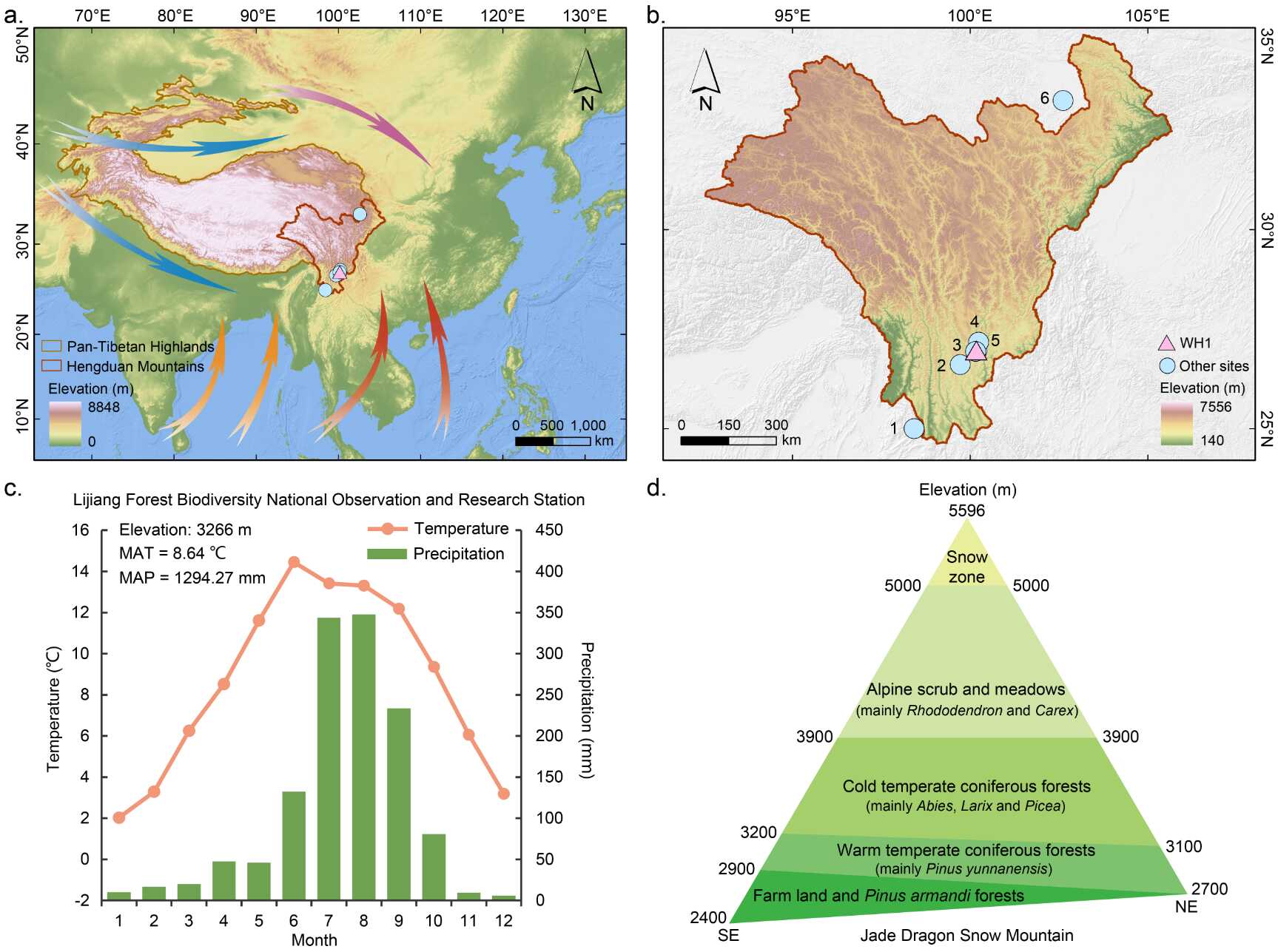
Location of the Hengduan Mountains (a, b), modern climate (c) and vegetation (d) in the study area (Image by YAO Yifeng)
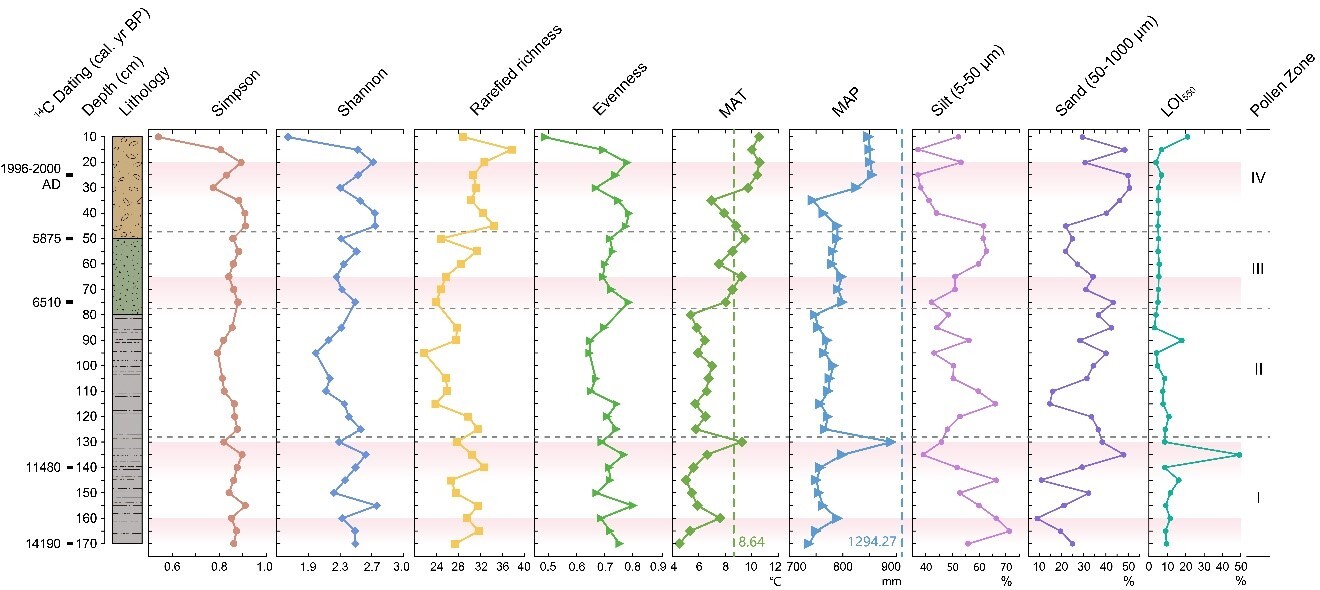
Curves showing plant diversity and climate change over the past 14000 years in the study area (Image by YAO Yifeng)