News
Wetland Drainage Triggers Divergent Soil Carbon Responses in Carbon-Poor versus Carbon-Rich Wetlands
A recent study published in Global Change Biology reveals a transcontinental divergence in soil carbon stock responses to decades of wetland drainage, challenging the widely accepted assumption that drainage generally causes wetland soil organic carbon (SOC) loss.
Led by Prof. FENG Xiaojuan from the Institute of Botany of the Chinese Academy of Sciences (CAS), the researchers conducted a transcontinental, pairwise survey of 29 pairs of drained and waterlogged sites (including 188 soil profiles, 2437 subsamples), spanning low- to high-latitude wetlands in China and Finland. They employed high-resolution sectioning of soil cores and the equivalent ash mass method to compare SOC stocks in the drained vs. waterlogged soil profiles to avoid potential bias caused by bulk density change.
The study found that drainage increased SOC stocks by 46±27% in carbon-poor wetlands, due to enhanced plant inputs. In contrast, SOC stocks decreased by 32±10% in carbon-rich wetlands following drainage, primarily due to the replacement of Sphagnum with vascular plants and enhanced decomposition.
Upscaling analysis revealed that drainage alone (without post-drainage disturbances) had led to a 1.80 Gt SOC gain in China over the past century, surpassing afforestation-driven SOC gains in northern China during the past three decades by 7.5-fold.
This study presents the first transcontinental, pairwise assessment of drainage impacts on wetland SOC stocks across broad climatic and vegetational gradients.
These findings highlight the overlooked climate mitigation potential of carbon-poor wetlands under shifting hydrological regimes. The researchers suggest that future wetland conservation and restoration strategies should be tailored to specific wetland types. Incorporating this context-dependent framework into Earth system models will help improve projections of wetland-climate feedbacks and support more informed conservation and management efforts.
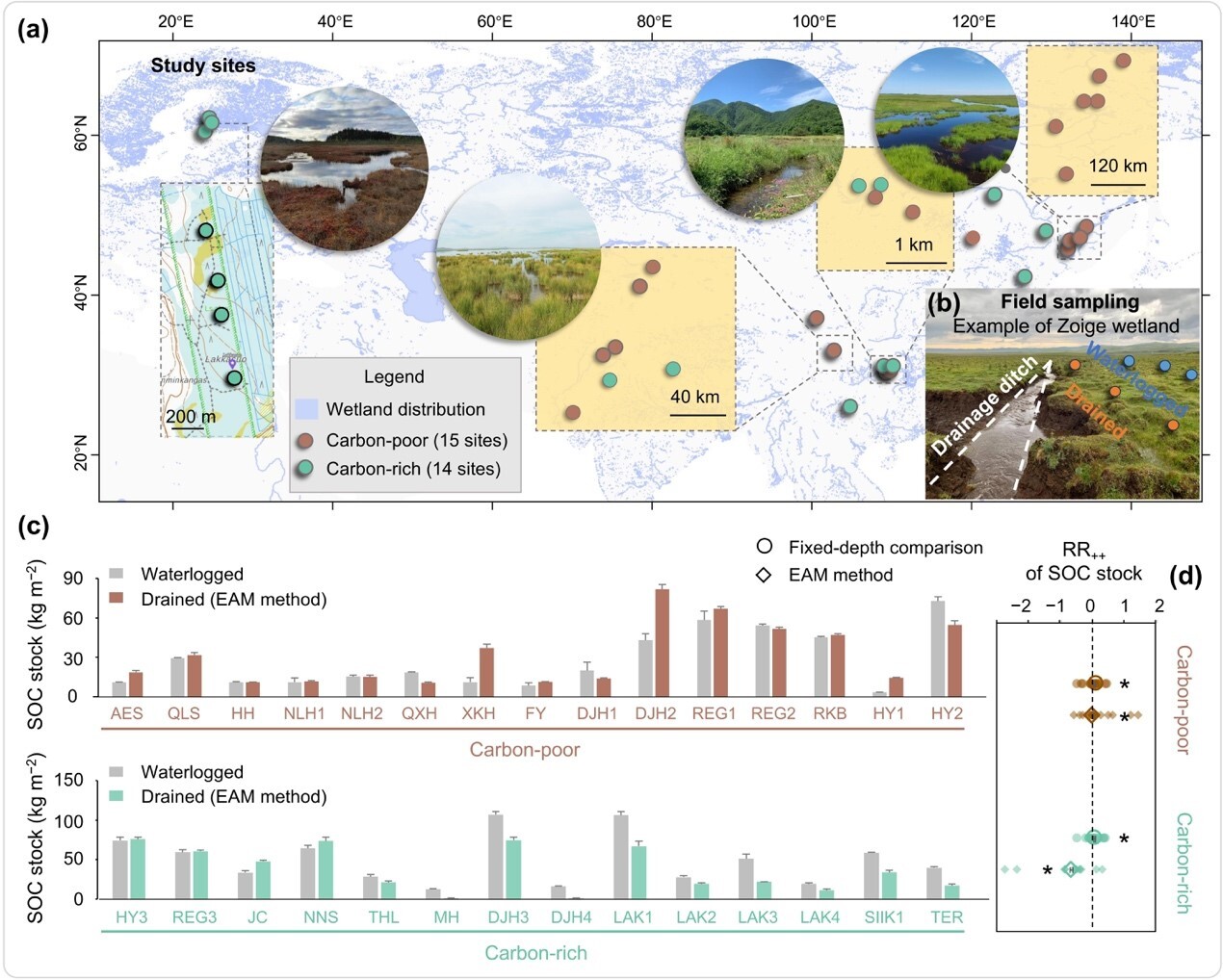
Sampling sites and response of soil organic carbon stock to drainage (Credit by LIU Chengzhu, ZHAO Yunpeng & LI Xuefei)