News
Researchers Reveal Nonlinear Temporal Shift In Soil Respiration Under Nitrogen Addition
Nitrogen deposition has long been recognized as an important driver of terrestrial carbon sequestration. A research team led by Prof. FANG Jingyun and Prof. SHEN Haihua from the Institute of Botany of the Chinese Academy of Sciences, revealed a shift from progressive positive to negative in the effects of nitrogen addition on soil respiration (Rs) over time.
The study was published in PNAS, addressed a previously unresolved question: how the effect of nitrogen deposition on Rs changes over time.
In this study, the researchers synthesized the effects of nitrogen addition on Rs from manipulation experiments across global forests and grasslands, using long-term Rs records each spanning at least five years.
They found a systematic transition in Rs responses to nitrogen addition from short-term stimulation to long-term suppression. The responses followed a nonlinear temporal trajectory, with a rapid early decline that gradually leveled off over time.
Nitrogen addition rate did not significantly change the pace of this decline, but higher nitrogen inputs produced stronger overall suppression. When treatments were classified into low- and high-rate categories based on the median addition rate in the analyzed dataset (50 kg N ha-1 y-1), high-rate nitrogen addition reduced Rs by approximately 11%, whereas low-rate addition had no significant overall effect.
This study extends the prevailing static-response paradigm by showing that the effects of nitrogen enrichment on soil carbon fluxes are strongly dependent on exposure duration and cumulative nitrogen input. The findings suggest that models need to capture these temporal dynamics, rather than assume a constant response, to accurately predict land–atmosphere carbon exchange under global change.

A nitrogen-addition experiment in a boreal forest stand dominated by Larix gmelinii in Inner Mongolia, China (Image by XING Aijun)
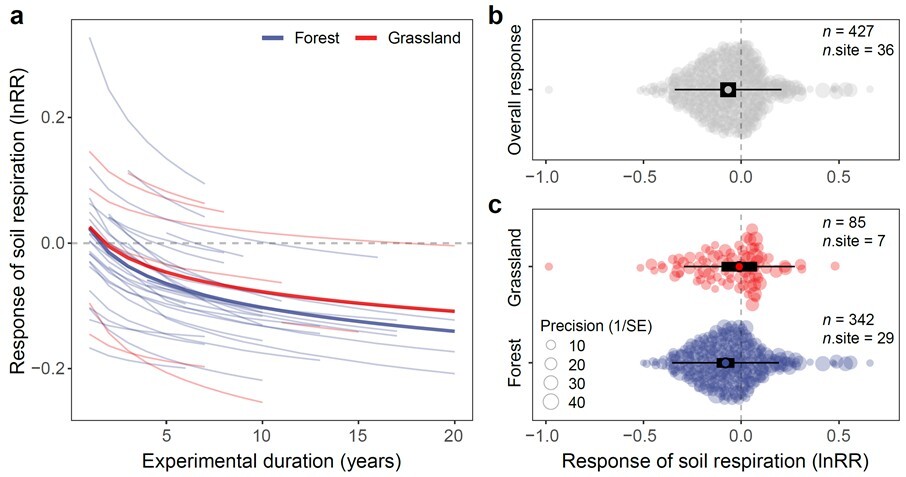
Temporal dynamics of soil respiration response to long-term experimental nitrogen addition (Image from XING et al., PNAS, 2026)