News
Conflicting Functional Demands Drive the Stepwise Evolution of Integrated Reproductive Structures in Liverworts
A research team led by Prof. XU Bo of the Institute of Botany, Chinese Academy of Sciences, has uncovered how lineage-specific adaptations of female reproductive structures in the liverwort Marchantia polymorpha facilitate successful fertilization on land.
Published in Nature Plants, the findings reveal how competing functional demands can shape the course of evolution and drive the stepwise assembly of complex and integrated traits.
Fertilization mediated by motile sperm remains widespread across major groups of land plants, including bryophytes, lycophytes and ferns. Bryophytes are particularly intriguing because their gametophyte – the stage that produces gametes- is their main plant body. This stage must accommodate two contrasting reproductive demands: water-dependent fertilization and effective spore dispersal, which benefits from exposure to drier conditions. Understanding how bryophytes balance these competing requirements could offer key insights into the structural innovations that enabled plants to reproduce successfully on land.
The researchers have identified a previously unknown water-transport system in M. polymorpha that moves water upwards against gravity. This helps deliver water to elevated female reproductive organs and facilitating fertilization. This system relies on an integrated network of specialised surface structures on the female reproductive stalk and receptacle. The coordinated development of these structures is regulated by a single GRAS-family transcription factor called MpLAS. This finding highlights how strong selective pressures could favor the precise integration of multiple structural components.
The study further identified a second regulator, a GRAS-family protein called MpGRAS10, which plays a key role in forming the stalk of reproductive structures. By promoting the expression of the gibberellin biosynthesis genes MpKAOL1 and MpKAOL2, MpGRAS10 contributes to the development of elevated reproductive structures that can enhance spore dispersal.
Comparative evolutionary analyses revealed that stalk evolved before the specialised surface structures associated with efficient fertilization. This supports a stepwise model for the evolution of the female reproductive structure: an initial innovation enhanced spore dispersal, while subsequent adaptations addressed its limitations in water delivery and fertilization. Rather than evolving as a single, coordinated innovation, the integrated structure appears to have emerged through successive modifications shaped by contrasting reproductive requirements.
Taken together, the findings show how competing functional demands can drive the sequential evolution of complex biological structures. By connecting transcriptional regulation, hormone biosynthesis, morphogenesis and evolutionary innovation, this study offers a framework for understanding how integrated traits emerge and diversify. It could also inspire biomimetic research into passive, directional liquid-transport systems, with potential relevance to bioinspired engineering and related fields.
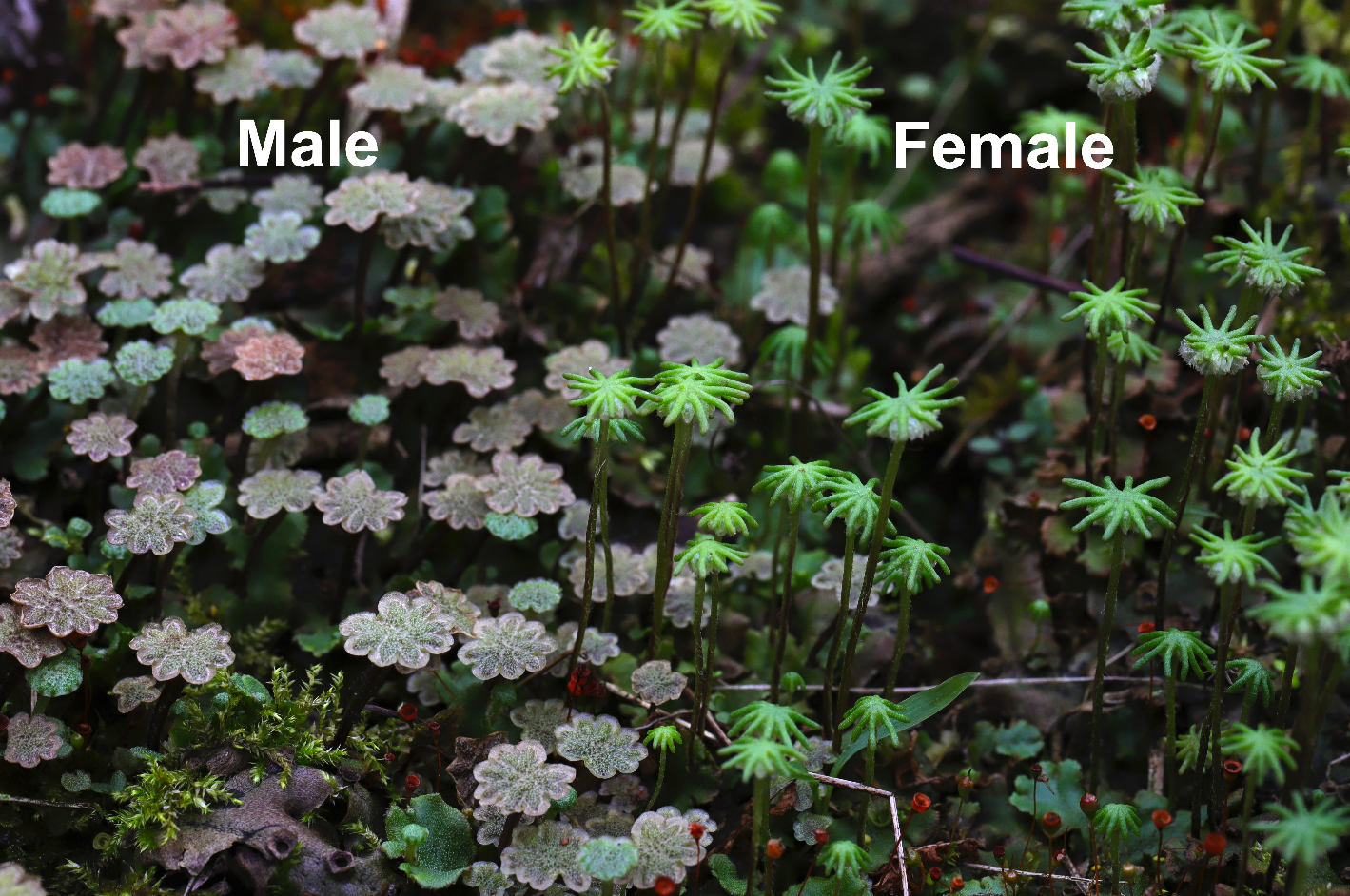
Male and female colonies of Marchantia polymorpha growing in their natural habitat, with reproductive structures visible where the two sexes meet at the boundary between colonies. Photograph by QI Xiaotong.