News
Evolutionary History Shapes Plant Carbon Storage Strategies Worldwide
A global synthesis led by YAN Zhengbing from the Institute of Botany, Chinese Academy of Sciences, emphasizes that evolutionary history plays a stronger role than contemporary environmental conditions in shaping plant non-structural carbohydrate (NSC) storage.
This study, published inNature Ecology & Evolution, compiled a global NSC database containing 29,386 field measurements during the growing season from 2,041 species across 1,016 sites, providing the first global assessment of organ-specific NSC distribution.
By integrating environmental datasets and phylogenetic information, the researchers found pronounced organ-specific NSC variability. Environmental conditions including water availability, temperature, and solar radiation induce the contrasting latitudinal patterns: leaf NSCs increased toward higher latitudes, whereas stem and root NSCs declined.
Beyond environmental controls, considerable phylogenetic signals of NSC variations demonstrate that closely related species may share similar carbon storage strategies. Along long-term evolutionary trajectories, more recently diverged taxa exhibit lower NSC concentrations in leaves, but store higher NSC concentrations in stems and roots.
Crucially, plant evolutionary history—including both phylogenetic relatedness and species identity—accounted for 55.9-77.1 % of global NSC variability, substantially exceeding contemporary environmental conditions, which explained only 2.4-9.2% of the variance. The findings suggest that plant carbon storage is not merely a passive response to environmental change, but is deeply rooted in evolutionary history, which offers a benefit through diverse carbon storage strategies.
This study has important implications for understanding vegetation responses under climate change. While prevailing vegetation models simplify plant NSC as a passive storage pool in response to climate, the researchers highlight that underlying evolutionary impacts are crucial for plant carbon storage and allocation strategies.
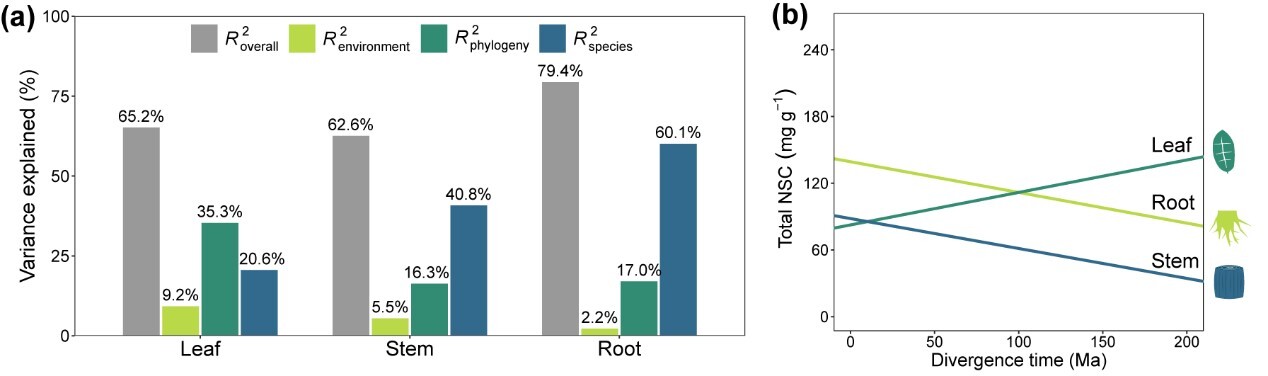
The effects of evolutionary history (including both phylogeny and species) on plant total non-structural carbohydrates and their organ-specific evolutionary trajectories along divergence time. (Image by XU Weiying & YAN Zhengbing)