News
A Case Study in Tree Grapes (Cyphostemma) Reveals the Genomic and Ecological Drivers of Arid Adaptation
In the context of global warming and intensifying aridity, understanding how plants adapt to extreme habitats has become a focus in biodiversity and evolutionary biology research. Recently, a new study led by Prof. LU Limin from the Institute of Botany, Chinese Academy of Sciences, deciphered the genetic basis and ecological mechanisms of adaptation to arid environments in the tree grape genusCyphostemma(Vitaceae).
Succulence has emerged independently across plant lineages during their adaptation to aridity, suggesting a high degree of evolutionary flexibility. Cyphostemma consists of about 200 species, mainly distributed in continental Africa and Madagascar, with a few species extending into tropical Asia. Cyphostemma species occupy a remarkable range of habitats, from rainforests to deserts, and display extensive morphological variation, where succulence emerges correspondingly in arid habitats, providing an ideal model for studying the evolution of succulence.
Based on extensive global sampling, the research team first reconstructed a robust phylogenetic framework and the biogeographic history of Cyphostemma. The results show that the four major clades of Cyphostemma underwent rapid diversification during the Eocene. Subsequently, with global cooling and increasing aridity in the Oligocene, succulent lineages have emerged independently in different clades.
Within the biogeographic framework, the study assembled high‑quality, chromosome‑level genomes of two representative species from contrasting habitats, C. dehongense, a climber from Asian forests, and C. currorii, a succulent shrub from the Namib Desert. The results show that a type of mobile genomic element, long terminal repeat retrotransposons (LTR‑RTs), proliferated actively during the radiation of Cyphostemma. Notably, some LTR‑RT lineages preferentially insert into introns, leading to significant intron expansion in the grape family, particularly in Cyphostemma, compared to other super-rosid plants.
Further investigation into the genome of succulent species C. currorii shows that the intron‑preferring LTR‑RT lineages exhibit high turnover rates, continuously generating substantial genomic variation, which may promote the emergence of succulence by affecting genes related to DNA repair and cell cycle regulation. Notably, the rapid diversification of these LTR‑RT lineages is consistent with the arid adaptation of Cyphostemma, suggesting a link between LTR-RT activity and the emergence of key innovations. Furthermore, using environmental data, the study reveals that the proliferation of LTR‑RTs in intergenic regions contributed to genome expansion in succulent Cyphostemma species, which is significantly correlated with dry and seasonal habitats.
Combining macroevolution with genomics, this study demonstrates that both intrinsic LTR‑RT activity and extrinsic environmental factors shape the arid adaptation of Cyphostemma species. Specifically, stochastic LTR‑RT activity enhances genomic evolvability, thereby increasing the potential for adaptation under arid conditions. This work deepens the understanding of plant arid adaptation mechanisms and provides new insights into adaptive evolution under global climate change.
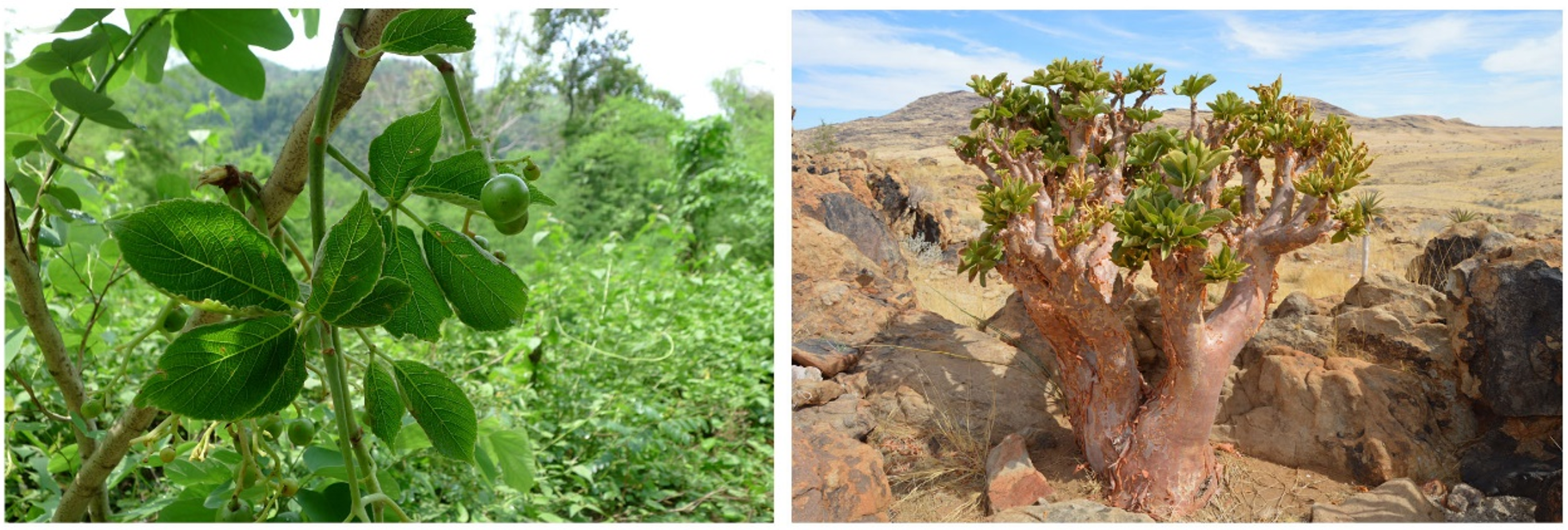
Fig. 1 Two representative Cyphostemma species used in this study. Left: C. dehongense (photo by Limin Lu). Right: C. currorii (photo by Patemoshela Kashikola).
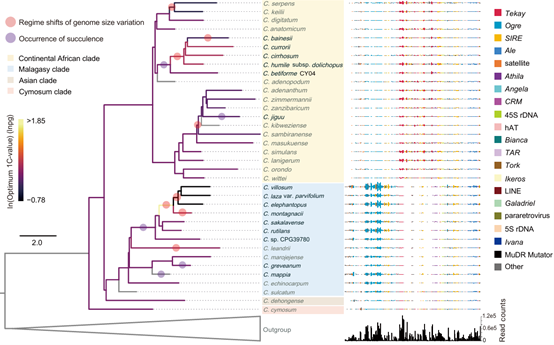
Fig. 2 Patterns of genome size evolution and repeat compositions in Cyphostemma species
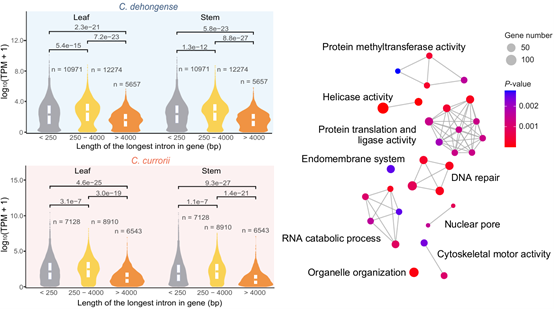
Fig. 3 Changes in gene expression level and gene function caused by intronic LTR-RT insertions in C. currorii