News
Phosphorus Addition Reshapes Phosphorus Cycling Across Global Terrestrial Ecosystems
Phosphorus (P) is an important element that limits plant growth and the productivity of terrestrial ecosystems. A recent study published in Global Change Biology reveals that P addition systematically reshapes P cycle in terrestrial ecosystems worldwide, shifting ecosystem from P recycling systems toward acquiring and alleviating ecosystem P limitation. This work provides the first comprehensive, plant–soil–microbe integrated assessment of how anthropogenic P inputs alter P dynamics across global natural ecosystems.
Led by Prof. FANG Jingyu and Prof. YAN Zhengbing, collaborated with Prof. SHEN Haihua, the research team from the Institute of Botany, Chinese Academy of Sciences (IBCAS), compiled a global database of 1,315 observations from 176 published studies, spanning 159 natural terrestrial ecosystem sites. This meta-analysis quantified the overall effects of P addition on nine key P-cycling variables across plant, soil, and microbial compartments, and identified the ecological and environmental drivers underlying the variability of these responses.
The results showed that P addition significantly increased P concentrations in leaves, stems, roots, and litter, as well as in soil and microbial biomass. Meanwhile, P addition significantly reduced leaf P resorption efficiency and suppressed soil phosphatase activity, indicating that ecosystems shifted from conservative, recycling-based P strategies toward acquisition-based strategies as P limitation was alleviated.
Notably, different P-cycling components exhibited markedly different sensitivities to P addition. Stem P concentration and plant-available soil P were identified as the most responsive variables in aboveground and belowground P cycling, respectively. Ecosystem P responses also varied significantly across climate zones: compared with temperate and boreal regions, tropical ecosystems showed greater sensitivity in stem P concentration and soil phosphatase activity. Further analyses revealed that the variability in P-cycling responses to P addition was primarily governed by background nutrient availability, climatic conditions, and fertilization regimes.
This study provides a holistic, quantitative understanding of how P addition reshapes P cycling and P dynamics across global terrestrial ecosystems. By integrating plant, soil, and microbial P compartments within a unified analytical framework, the findings advance the mechanistic understanding of terrestrial P dynamics, P limitation, and biogeochemical coupling.
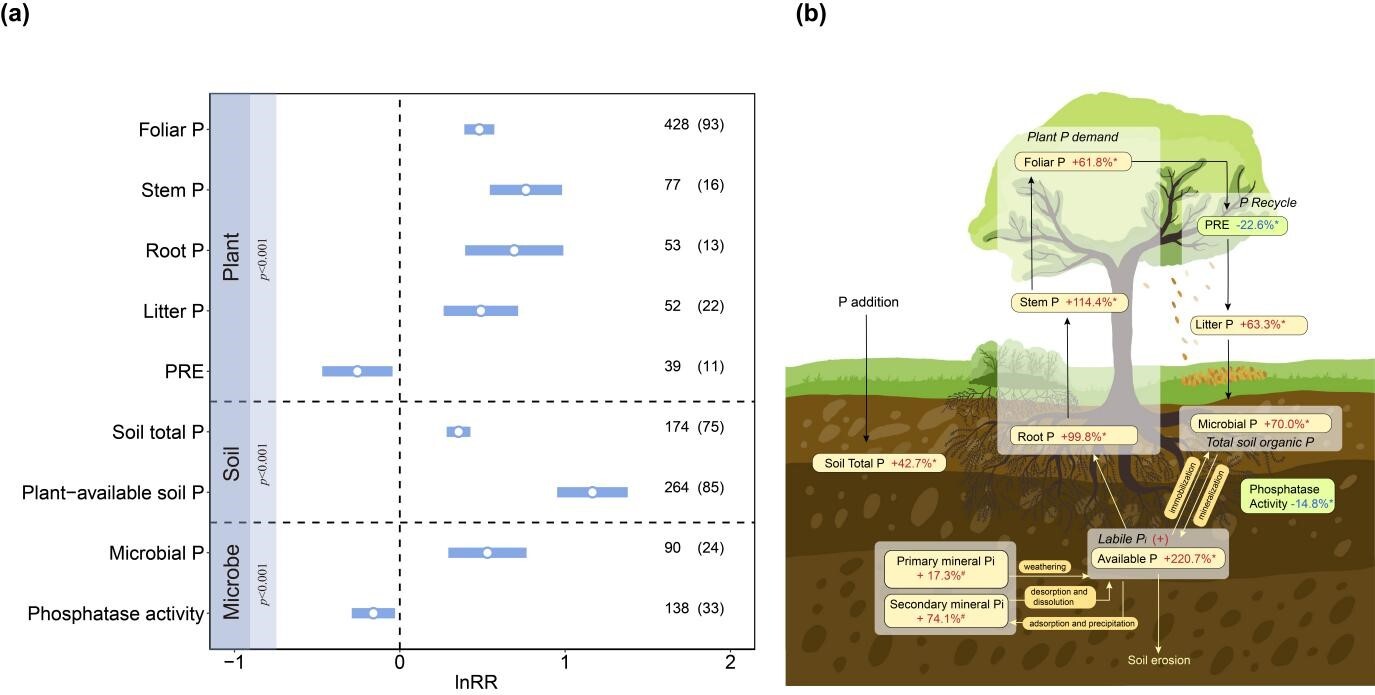
Overall effects of phosphorus addition on phosphorus cycling in terrestrial ecosystems (Image by CHEN Zixin, FANG Jingyun and YAN Zhengbing)