News
-
 A Scientific Cooperative Agreement was signed between IBCAS and IBMASIn order to further promote the Sino-Mongolia cooperation in scientific research, Institute of Botany, Chinese Academy of Sciences and Institute of Botany, Mongolian Academy of Sciences signed an agreement on the collaboration between the two institutions on 18th May, 2009. Prof. Dr. Kang Chong, Deputy Director of IBCAS and Dr. TuvshinTogtokh, Director of IBMAS signed the agreement respectively.May 21, 2009
 -
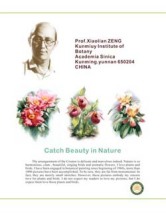 Works of CAS botanical artists highlighted at int'l workshopBotanical illusions of two experts from the CAS Kunming Institute of Botany ZENG Xiaolian and YANG Jiankun were on the spotlight at the International Conference, Exhibition and Illustration Workshop held from July 30 to August 4 in Chiang Mai, Thailand. The conference was attended by some 100 experts from more than 20 countries or regions all over the world including China, the US, the UK, the Holland, Denmark, Switzerland, Japan, the ROK, Singapore and Thailand. Before the origin and development of languages the human beings communicated through illustrations and symbols. This was depicted in ancient rock paintings and murals. As civilization marched ahead only the media and the dyes used for paintings were changed. Scientific illustration is of recent origin dating back to the 17th century. Within this short period it hasApr 07, 2009
 -
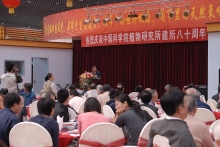 Institute of Botany Held Greeting Ceremony and High-end Academic Forum to Celebrate the 80th AnniversaryOn the morning of September 28th, representatives of former leaders, Academicians of CAS, staffs and students gathered to celebrate the 80th anniversary of the Institute of Botany.Oct 05, 2008
 -
A Scientific Cooperative Agreement was signed between IBCAS and IBMASMay 21, 2009
-
Professor Peter H. Raven visited IOBJul 16, 2009
-
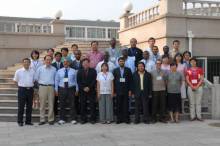 China-Aid Project “the International Training Course for Establishment and Management of Field Research Station” Ended Successfully on 22 July in BeijingSponsored by the Ministry of Commerce of China, undertaken by Institute of Botany, the China-Aid Project “the International Training Course for Establishment and Management of Field Research Station” started on 23 June and ended successfully on 22 July in Beijing.Jul 30, 2008
 -
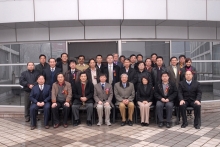 New plant R&D center to address energy issuesThe joint launching ceremony for the Research and Development Center for Energy Plants, the CAS Institute of Botany (IOB), and the R&D Laboratory for Sweet Sorghum, which is to be co-established by IOB and the Temasek Life Sciences Laboratory (TLL) in Singapore, was held on 10 December at IOB in Beijing.Dec 10, 2007
 -
Large-scale gardens for energy-rich plants to be set up at CASFeb 28, 2007
-
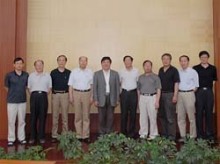 Plant ecologist to head the CAS Institute of BotanyJun 20, 2006
 -
Plant Genomics in ChinaJun 27, 2005