News
Projected Global Grassland Expansion and Northward Shift by Century's End
A recent study published in Journal of Geophysical Research: Biogeosciences, has revealed that the global grassland coverage will likely increase at the end of this century.
Led by Prof. WANG Yufei from the Institute of Botany of the Chinese Academy of Sciences, along with international collaborator from Austria, the researchers created a data set containing 16,372 records with both characteristic variables (including vascular plant richness, bioclimatic, soil and elevation variables) and Poaceae pollen abundance (PA) and used a random forest model to simulate the spatial distribution of Poaceae PA.
They found a significant difference in the distribution of Poaceae PA across continents, with regions of higher abundance (e.g., ∼10% in temperate regions and ∼40% in tropical regions) closely aligned with the distribution of grasslands.
Furthermore, the study projected the distribution of grass PA under four future climate scenarios (Shared Socioeconomic Pathways (SSP) 126, 245, 370, 585) and the changes of grasslands, and found that the temperate grasslands in the Northern Hemisphere are expected to expand northwards based on all the scenarios, whereas the Amazon savannas will also expand, thus encroaching on rainforests.
This work offers new insights into the future development of grasslands for both the scientific community and policy-makers.
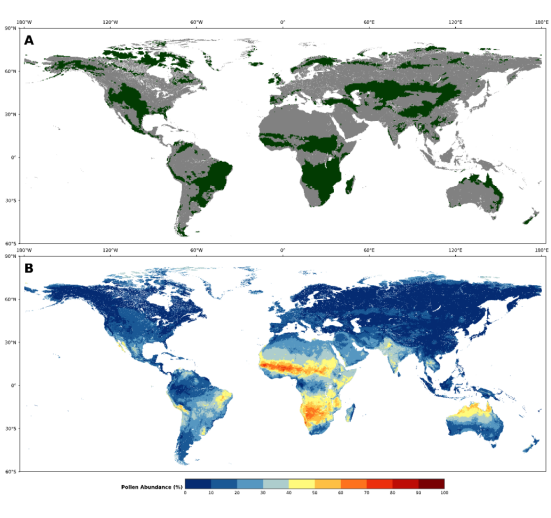
The modern distribution of global grassland (A) and the simulated spatial pattern of Poaceae pollen abundance (B) show a good coupling between the higher Poaceae pollen abundance in temperate and tropical regions and the actual distribution of grassland (Image by YAO Yifeng)