News
Researchers Reveal Temperature Sensing Mechanism for Timekeeping in Plants
The greenhouse effect leads to a gradual increase in global temperatures. How do plants sense temperature change and still maintain the robust circadian rhythms with an approximately 24 h period is largely unclear. A research team led by Prof. WANG Lei from the Institute of Botany of the Chinese Academy of Sciences (CAS) revealed that a key protein inside plants, clock component PSEUDO-RESPONSE REGULATOR 9 (PRR9), has evolved for thermal adaptation and acts as a crucial player for transmitting temperature signals to keep accurate timing in plants. The study was published in Developmental Cell.
"This study revealed that a three-part regulatory module, composed by phyB, PRR9 and ALKBH9B, acts like a temperature sensory module and messenger. It transmits temperature signals into the core circadian oscillator, and maintains daily rhythmic behaviors in varying temperature changes. This sheds light on the molecular innovations that enabled plants to sense rising temperature and the warming climate", said Prof. WANG Lei.
Researchers found that, at cooler temperatures, a well-known photoreceptor phyB acts as the main thermometer. It grabs onto PRR9 inside structures called nuclear speckles, spatially sequestering PRR9 from binding to the promoters of the morning-phased circadian genes, such as CIRCADIAN ASSOCIATED 1 (CCA1). This weakens the transcriptional inhibitory activity of PRR9 protein and delays its transcriptional inhibition phase. When temperature rise, phyB and PRR9 interact diffusely in the nucleus, which releases the functional inhibition of PRR9.
When plants are exposed to long-term high-temperature conditions such as seasonal temperature change, the plant takes two additional steps. First, PRR9 protein is accumulated, which further suppresses CCA1. Second, higher temperature promotes PRR9 to team up with another protein, the RNA m6A demethylase ALKBH9B, in the cellular cytoplasm. This partnership removes the m6A modification on CCA1 mRNA and accelerates its degradation. Together, these two layers of control- at both cytoplasmic and nuclear levels, allow PRR9 precisely maintains the circadian clock period at roughly 24 hours by strictly regulating CCA1 levels, even when the heat is on.
The team points out that, the plant circadian clocks possess sophisticated and complex high-temperature sensing and regulatory mechanisms. This is beneficial for plants to maintain the robustness of core circadian functions in continuously warming temperatures, thereby better adapting to the gradually warming climate. These findings may provide an important theoretical foundation for engineering thermo-resilient crops through molecular design breeding approaches in the future.
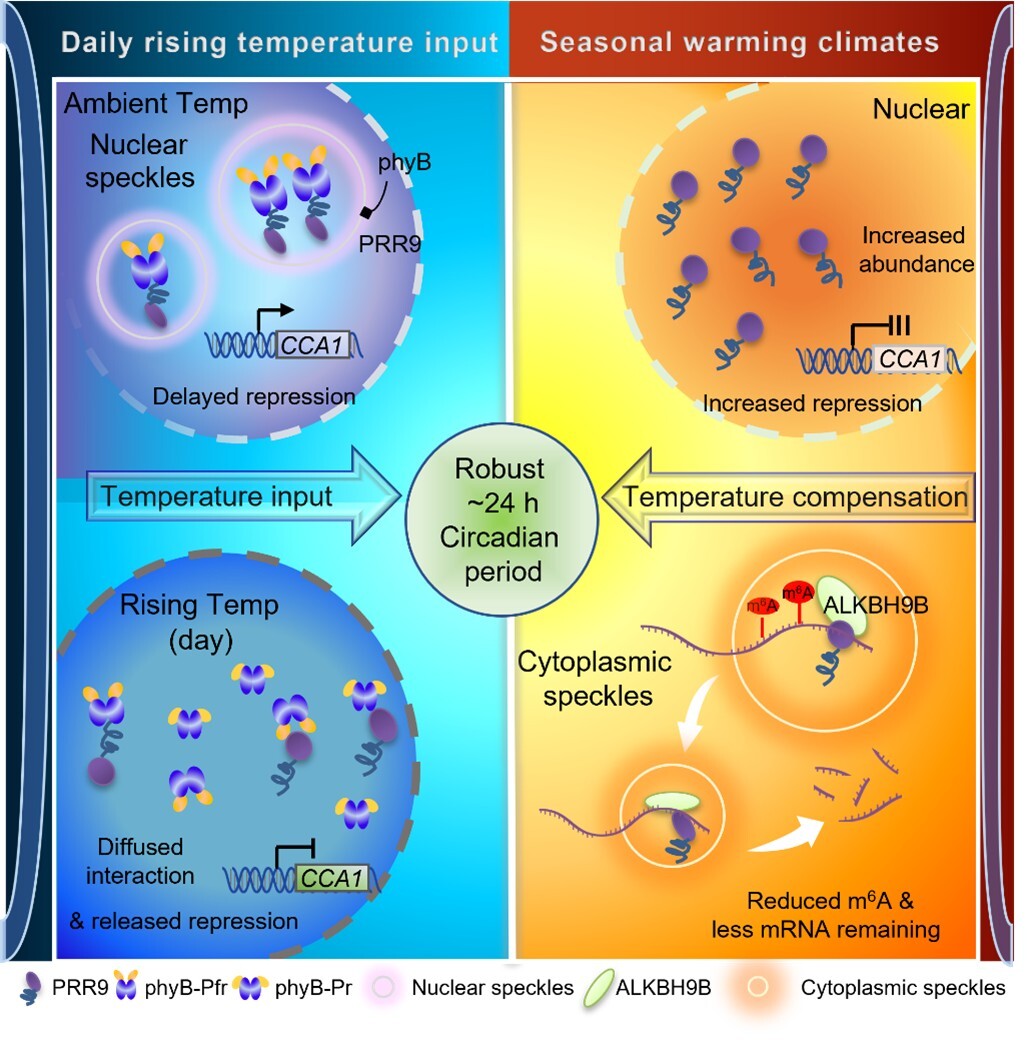
Graphical representation of the thermoregulatory module for timekeeping
(Image by HE Yuqing and WANG Xiling)
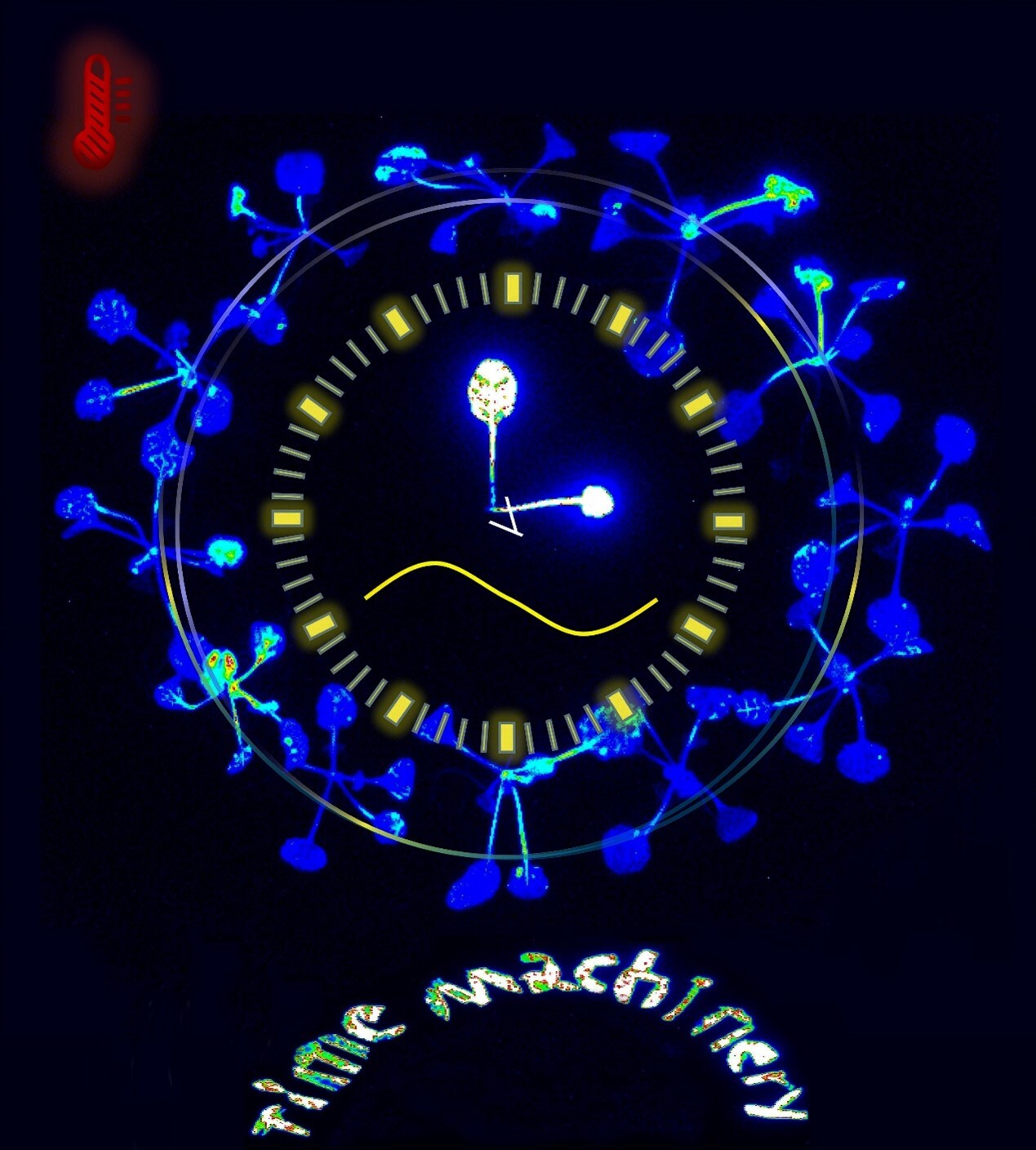
Circadian clock maintains stable and robust rhythms at high temperature (Image by HE Yuqing and WANG Lei)