News
High-Latitude Permafrost Regions Show Stronger Temperature Sensitivity of Soil Organic Matter Decomposition Than High-Altitude Permafrost Regions
A recent study has revealed strong regional differences in the temperature sensitivity (Q10) of soil organic matter decomposition between high-latitude and high-altitude permafrost regions. The researchers found that Q10 values in high-latitude soils were about 1.8 times higher than those in high-altitude soils. The findings, recently published in National Science Review, suggest that high-latitude permafrost regions could be substantially more vulnerable to soil carbon loss than high-altitude permafrost regions under future warming scenarios.
Led by Prof. YANG Yuanhe from the Institute of Botany of the Chinese Academy of Sciences, the researchers collected topsoil samples across the Tibetan Plateau (high-altitude permafrost region) and Northeast China (high-latitude permafrost region), and conducted a 368-day laboratory incubation experiment. They also integrated the published Arctic permafrost datasets. Based on these comprehensive measurements and integration, this study provides the first large-scale evidence of contrasting Q10 patterns and identifies key drivers across distinct permafrost environments.
The results indicate that Q10 variation is directly driven by microbial traits and mineral protection. In contrast, climate, soil characteristics, and soil organic carbon quantity influence Q10 indirectly by shaping microbial diversity, life history strategies, and carbon-degrading genes, as well as mineral stabilization that regulates carbon bioavailability. The findings emphasize the need to incorporate spatial variability in microbial and mineral controls into model parameterization to improve predictions of permafrost carbon feedbacks to climate change.
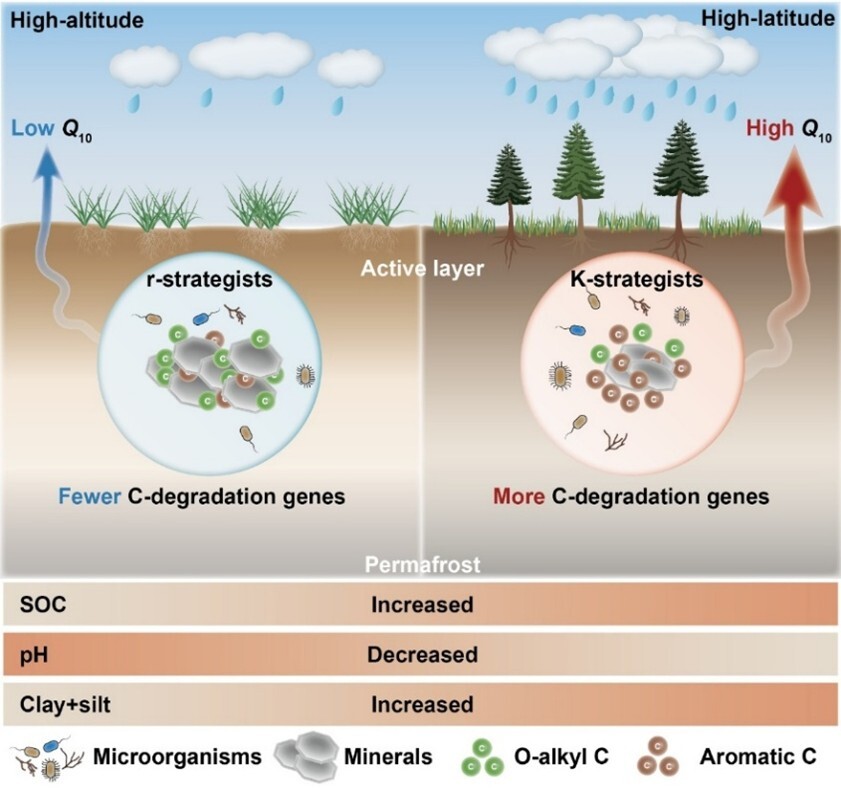
Differences in the temperature sensitivity of soil carbon decomposition between high-latitude and high-altitude permafrost regions and their driving factors (Image by YANG Yan).

The landscape photos of permafrost regions in high-altitude ( the Tibetan Plateau) and high-latitude (Northeast China) areas (Image by YANG Yan).