News
【约稿】【embargo until 17:00 OCT 14】Canopy Structure Regulates Autumn Phenology by Mediating Microclimate in Temperate Forests
Recently, a research team led by Prof. SU Yanjun from the Institute of Botany, Chinese Academy of Sciences, reveals that canopy structure significant influencing local-scale variations in autumn phenology by mediating microclimate conditions. Integrating the "canopy structure-microclimate-autumn phenology" pathway into existing autumn phenology models has enhanced prediction accuracy and improved forecasts of future changes in autumn phenology. These findings offer new insights into the mechanisms driving local-scale variation in temperate forest autumn phenology and its response to climate change.
Autumn phenology serves as a sensitive indicator of temperate forests' response to climate change and is a key factor influencing forest carbon sequestration. Understanding the mechanisms driving the spatiotemporal variations in autumn phenology is crucial for accurately predicting the responses of temperate forests to climate change and their carbon sink capacity.
Current research primarily focuses on the effects of macroclimate on autumn phenology; however, macroclimate does not account for local-scale variations in autumn phenology. Even within the same region, under similar macroclimatic conditions, significant spatial variability can be observed among trees of the same species. The underlying mechanisms driving these local-scale variations in autumn phenology remain unclear, necessitating further investigation.
To address these issues, the research team utilized light detection and ranging data and high spatiotemporal resolution imagery to quantify autumn phenology metrics and canopy structure attributes across six representative temperate forest sites. They found a significant and consistent relationship between the canopy structure and autumn phenology, which can be attributed to the influence of canopy structure on microclimate conditions.
Specifically, complex canopies delay the start of autumn by reducing light availability within the canopy and enhancing temperature buffering during the growing season. Light attenuation decreases photosynthetic activity and carbon uptake, particularly for understory trees, potentially delaying leaf senescence. Additionally, enhanced temperature buffering slows the accumulation of cold temperatures, reduces frost risk, which can further delay leaf senescence.
Integrating the "canopy structure-microclimate-autumn phenology" pathway into existing autumn phenology models significantly improves prediction accuracy. Existing autumn phenology models that do not consider this pathway overestimate the delaying effect of global warming on autumn phenology. These findings emphasize the urgent need to integrate the identified pathway into Earth system and vegetation models, especially considering the asynchronous changes of macroclimate and microclimate conditions.
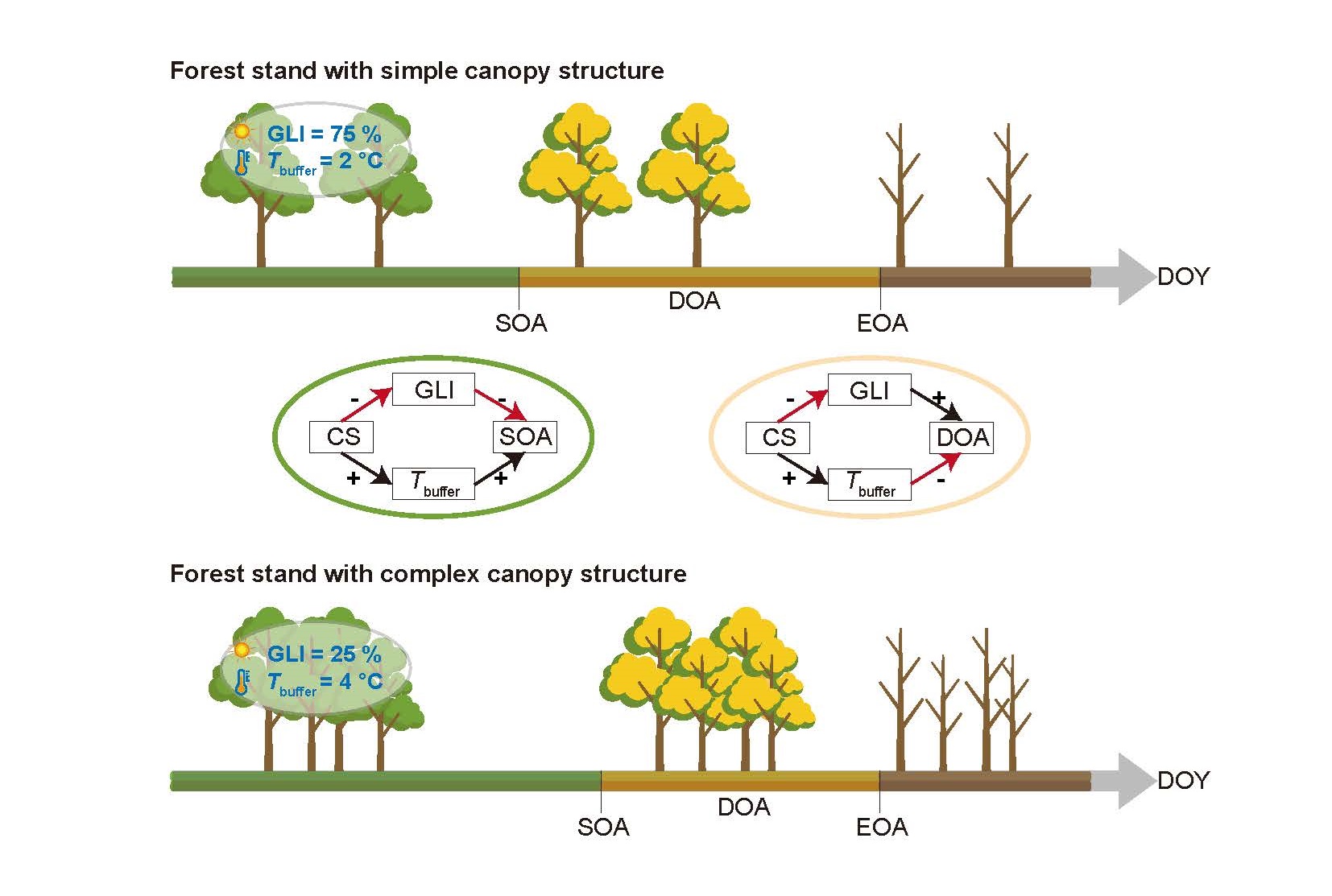
Figure 1. A conceptual diagram of the influence of canopy structure on autumn phenology in temperate forests by mediating microclimate conditions (Image by Xiaoyong Wu and Yanjun Su)
The study was published in Nature Climate Change on October 14, 2024, and was funded by the Frontier Science Key Programs of the Chinese Academy of Sciences and the National Natural Science Foundation of China.