News
Scientists proposed a generalized modeling system for plant lateral organ development and evolution
Plant lateral organs, such as leaves, sepals and petals, come in many shapes. Peltate organs, such as the prey-capturing traps of carnivorous plants and nectary-bearing petals of ranunculaceous species, are widespread in nature and have intrigued and perplexed scientists for centuries. Shifts in the expression domains of adaxial/abaxial genes have been shown to control leaf peltation in some carnivorous plants, yet it is still unclear whether the mechanism is shared by other peltate organs.
Recently, a research team led by Prof. KONG Hongzhi from Institute of Botany, Chinese Academy of Sciences (IBCAS), provided new insights into the mechanisms of plant organ development and evolution.
The study was published in Science Advances on April 21.
The researchers first used petals of Nigella damascena as a model and conducted detailed morphological, 3D imaging, expression, computational and functional studies. They found that, like leaves, the formation of peltate Nigella petals was also caused by shifts in the expression of adaxial/abaxial genes.
Then, using the cutting-edge computational modeling techniques, they showed that the various peltate petals of ranunculaceous species were formed by the shifts of the expression patterns of the adaxial/abaxial genes in different ways, followed by differentiated regional growth sculpting the margins and/or other parts of the organs.
By introducing a few parameters to specify the time, position, and degree of the polarity shifts and growth, they further proposed a generalized yet powerful modeling system, through which various types of unifacial, bifacial and peltate lateral organs found in nature can be simulated.
These findings not only demonstrate the general mechanisms underlying plant lateral organ development and evolution but also highlight the importance of computational simulation in biological studies.
“To our knowledge, this is the first comprehensive work that addresses the mechanisms underlying the diversification of, as well as the transitions between, bifacial, unifacial and peltate organs, and provides a modern, experimentally testable interpretation for the development and evolution of lateral organs of plants,” said KONG Hongzhi from IBCAS, corresponding author of the study.
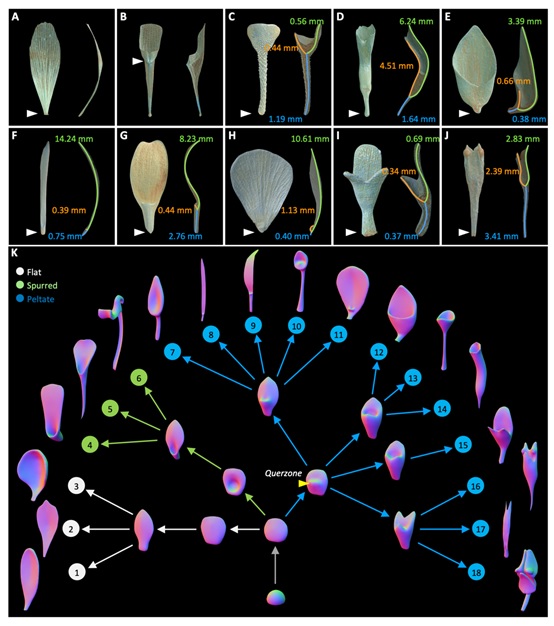
Structures and diversification of ranunculaceous petals (Image by CHENG Jie)
Article Link: TBD
Contact:
KONG Hongzhi
Institute of Botany, the Chinese Academy of Sciences
Email:hzkong@ibcas.ac.cn