News
-
 Mr. Meeuwes Brouwer, Chief Phytosanitary Officer of the Dutch Ministry of Agriculture, Fisheries, Food Security and Nature, and his delegation visited IBCASMar 20, 2026
 -
 Forest Canopy Leaves Absorb Atmospheric Nitrogen Through Age-Dependent MechanismsA recent study led by Dr. WANG Xin from the Institute of Botany, Chinese Academy of Sciences, quantified the foliar nitrogen uptake capacity of dominant canopy trees in natural tropical and subtropical forest ecosystems and revealed distinct regulatory mechanisms across leaf ages.Mar 09, 2026
 -
 Scientists Predict the Future of the Arctic flora Under Climate ChangeA team led by Prof. WANG Wei from the Institute of Botany of the Chinese Academy of Sciences (IBCAS) has predicted quantitatively the potential dynamic changes of the entire Arctic flora from now until 2100 under four greenhouse gas emission scenarios. The study was published in National Science Review.Mar 07, 2026
 -
 Scientists Discovered Regulatory Mechanisms of Photoprotection and Normal Chloroplast Development in MaizeA research team led by Prof. WANG Baichen at the Institute of Botany, Chinese Academy of Sciences (IBCAS), has identified regulatory mechanisms of photoprotection and normal chloroplast development in maize. This finding discovered a "magical" phenomenon in maize, where the leaves exhibit stripes that change with the day-night cycle, unveiling the molecular secrets behind it. This is all due to a malfunction in an internal "quality control system" within the chloroplast known as the Clp protease complex.Mar 03, 2026
 -
 Moss-Associated Nitrogen Fixation Helps Sustain Plant Growth in Warming Permafrost EcosystemsClimate warming can increase plant growth in permafrost regions by lengthening the growing season, speeding up plant metabolic processes, and allowing deeper root penetration as permafrost thaws. However, the capacity for additional vegetation to offset the carbon released during permafrost thawing depends on nitrogen supply.Feb 27, 2026
 -
 Elucidation of the Molecular Mechanism of TEF6 in Regulating High-Light-Induced PSII RepairFeb 12, 2026
 -
 Scientists Report Increased Rather Than Decreased Soil Carbon Accumulation in Boreal Sphagnum Peatlands Under WarmingA recent study shows that warming enhances soil carbon accumulation in boreal Sphagnum peatlands through increased plant productivity and iron protection as well as inhibited microbial decomposition. These responses stand in sharp contrast to the warming-enhanced soil carbon mineralization in boreal forests and tundra, demonstrating the vital but overlooked role of Sphagnum peatlands in counteracting boreal carbon loss under future warmingFeb 10, 2026
 -
 Chinese Scientists Discover Genetic "Molecular Target" Module for Wheat Flowering Time in Response to Climate ChangeA research team led by Professor CHONG Kang from the Institute of Botany, Chinese Academy of Sciences (CAS), in collaboration with the research group of Professor GUO Zifeng, has identified a molecular regulatory module that controls flowering time. This finding provides key genetic targets for the genetic improvement and adaptive breeding of wheat cultivarsFeb 09, 2026
 -
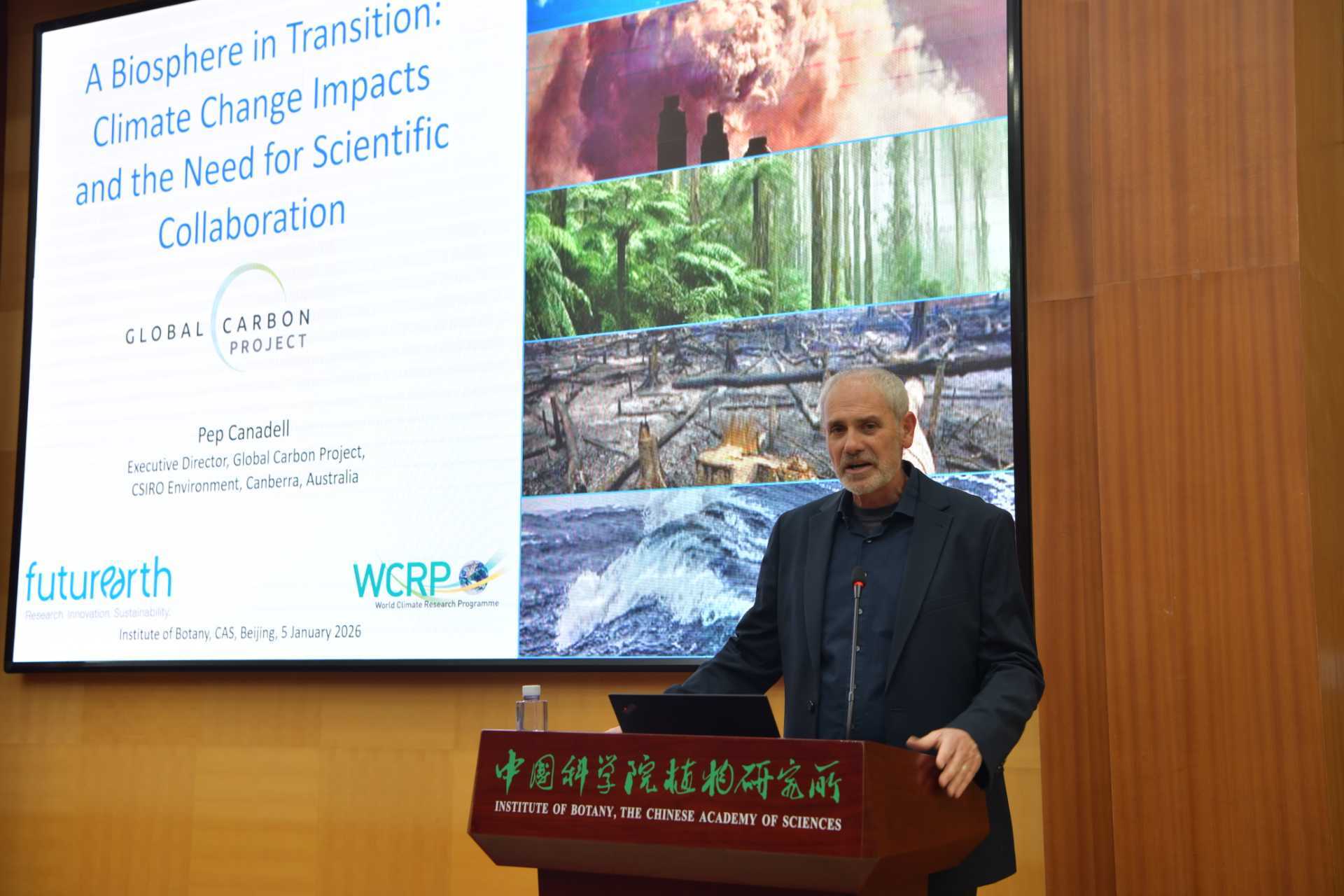 CAS PIFI Distinguished Scientist Josep G. Canadell Visited IBCASOn 5-14 January, Prof. Josep G. Canadell, a Chinese Academy of Sciences (CAS) President's International Fellowship Initiative (PIFI) Distinguished Scientist, Fellow of the Australian Academy of Science, and Fellow of the Australian Academy of Technological Sciences and Engineering, visited the Institute of Botany, Chinese Academy of Sciences (IBCAS) and delivered an invited lecture at the Hongye Forum. The forum was chaired by Prof. FENG Xiaojun, Deputy Director of IBCAS, and attracted more than 100 faculty members and students from multiple institutionsJan 19, 2026
 -
 Researchers Publish First High Resolution Global Atlas of Specific Leaf Area Under Climate ChangeA study led by Prof. XU Zhenzhu from the Institute of Botany, Chinese Academy of Sciences, has constructed the first high-resolution (1 km²) continuous spatial atlas of specific leaf area (SLA) across the globe, mapping its current distribution projecting future changes. The study reveals that under both present and future climate conditions, high-SLA plant species prevail in mid- to high-latitude regions of the Northern Hemisphere. Under the worst climate scenario (SSP5-8.5), SLA is projected to increase across most of the world’s biomes between 2021–2040 and 2081–2100. The work also reports global average SLA values, including observed estimates and variability ranges.Jan 21, 2026