
A global study published in Nature Communications provides the strongest evidence yet that leaf economic strategies are the key drivers of how terrestrial plants respond to phosphorus (P) enrichment worldwide.
Led by Prof. YAN Zhengbing from the Institute of Botany of the Chinese Academy of Sciences, the team synthesized 5,548 observations draw from 317 publications to quantify how individual plant biomass and biomass allocation respond to experimental P enrichment across global terrestrial ecosystems.
The results reveal striking differences among plant functional groups: Deciduous (45%), C3 (36%), and N₂-fixing species (54%) exhibit much stronger stimulation than evergreen (28%), C4 (19%), and non-N₂-fixing species (31%). These patterns align closely with the leaf economics spectrum, with plants characterized by more acquisitive traits exhibiting stronger responses to P addition.
The study further shows that climate and soil properties shape biomass responses primarily by influencing leaf functional traits. Beyond increasing total biomass, P addition also shifted allocation patterns, increasing aboveground investment while the root-to-shoot ratio declined by 5%.
By integrating functional traits, resource-use strategies and nutrient responses at global scale, this study provides critical insights for predicting how rising atmospheric P deposition will influence terrestrial productivity and carbon storage under future global change.
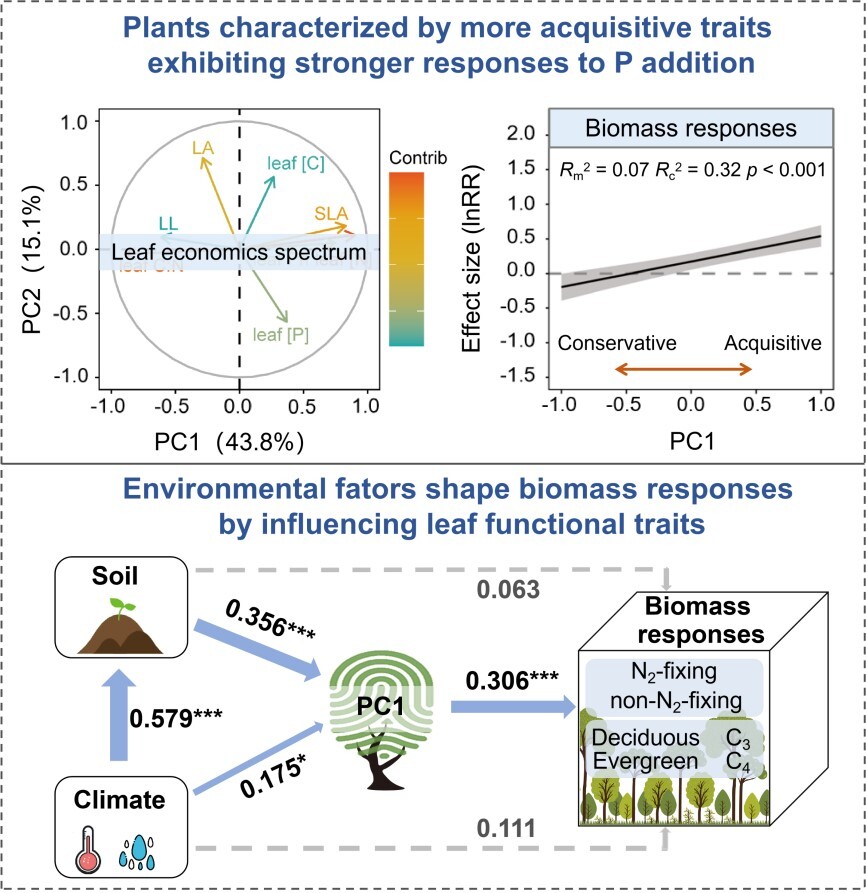
Leaf economic strategies drive plant biomass responses to phosphorus (P) addition (Image by YANG Nan & YAN Zhengbing). PC1 was derived from the principal component analysis (PCA) and depicted the leaf economics spectrum, which can be characterized by a single acquisitive-conservative axis.
A global study published in Nature Communications provides the strongest evidence yet that leaf economic strategies are the key drivers of how terrestrial plants respond to phosphorus (P) enrichment worldwide.
Led by Prof. YAN Zhengbing from the Institute of Botany of the Chinese Academy of Sciences, the team synthesized 5,548 observations draw from 317 publications to quantify how individual plant biomass and biomass allocation respond to experimental P enrichment across global terrestrial ecosystems.
The results reveal striking differences among plant functional groups: Deciduous (45%), C3 (36%), and N₂-fixing species (54%) exhibit much stronger stimulation than evergreen (28%), C4 (19%), and non-N₂-fixing species (31%). These patterns align closely with the leaf economics spectrum, with plants characterized by more acquisitive traits exhibiting stronger responses to P addition.
The study further shows that climate and soil properties shape biomass responses primarily by influencing leaf functional traits. Beyond increasing total biomass, P addition also shifted allocation patterns, increasing aboveground investment while the root-to-shoot ratio declined by 5%.
Leaf economic strategies drive plant biomass responses to phosphorus (P) addition (Image by YANG Nan & YAN Zhengbing). PC1 was derived from the principal component analysis (PCA) and depicted the leaf economics spectrum, which can be characterized by a single acquisitive-conservative axis.