
On 27 November, a delegation led by Prof. Tuvshintogtokh Indree, the Director of the Botanic Garden and Research Institute of the Mongolian Academy of Sciences (BGRI-MAS), visited the Institute of Botany, Chinese Academy of Sciences (IBCAS). The two sides held in-depth discussions on global climate change, plant community dynamics of the Mongolia steppe, and the ecological restoration of degraded grasslands. During the visit, IBCAS and BGRI-MAS renewed the cooperation agreement. Prof. YANG Yongfeng, the Secretary of the Party Committee of IBCAS, together with relevant staff from IBCAS participated in the exchange activity.
Prof. YANG Yongfeng welcomed the visit of the Mongolian delegation and introduced the basic situation and research directions of IBCAS. He also briefly reviewed the history of collaboration between IBCAS and BGRI-MAS. He expressed the hope that both sides will further deepen the mutual trust and broaden the cooperation in the future, and actively address the ecological and environmental issues faced by the grassland ecosystems in China and Mongolia.
Prof. Tuvshintogtokh Indree presented an overview of BGRI-MAS and its cooperation history with IBCAS. The research fields of BGRI-MAS include plant diversity and conservation, environmental restoration and reforestation, climate change and ecosystem. They have established multiple long-term ecological research stations across different ecosystems of Mongolia, and have carried out extensive collaborative research with several countries, such as China, Russia, the Czech Republic and Germany.
Prof. HUANG Zhenying gave a comprehensive overview of the sustained and deepening cooperation between China and Mongolia in grassland ecosystem research. Since 2009, IBCAS has successively established three long-term field platforms for nitrogen and water addition experiments in Mongolia’s meadow, typical, and desert steppes, amassing 16 consecutive years of observation data. Throughout this period, the two sides have maintained frequent visits and exchanges, and achieved fruitful cooperation results in areas such as talent cultivation, joint project application, and co-publication of fingdings.
Prof. YANG Yongfeng and Prof. Tuvshintogtokh Indree signed the cooperation agreement on behalf of their respective institutions. The two sides agreed to intensify visits and exchanges, co-organize international conferences, jointly apply for research projects, and establish joint laboratories.
This visit has laid a solid foundation for future collaboration. Both sides will strengthen cooperation on the responses and adaptations of grassland plant communities to global changes, grassland restoration and desertification prevention, the construction of joint laboratories, and talent cultivation, aiming to jointly contribute to the restoration and sustainable development of grassland ecosystems in the context of global environmental changes.
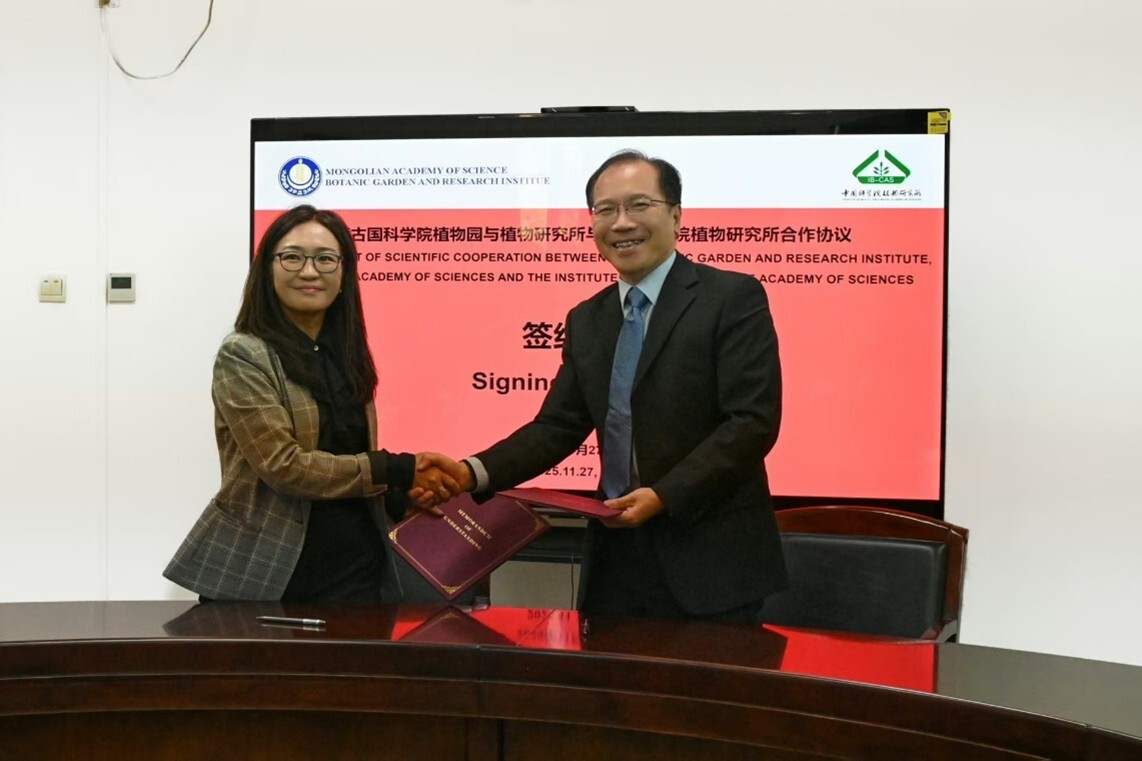
Prof. YANG Yongfeng and Prof. Tuvshintogtokh Indree signed the cooperation agreement on behalf of their respective institutions
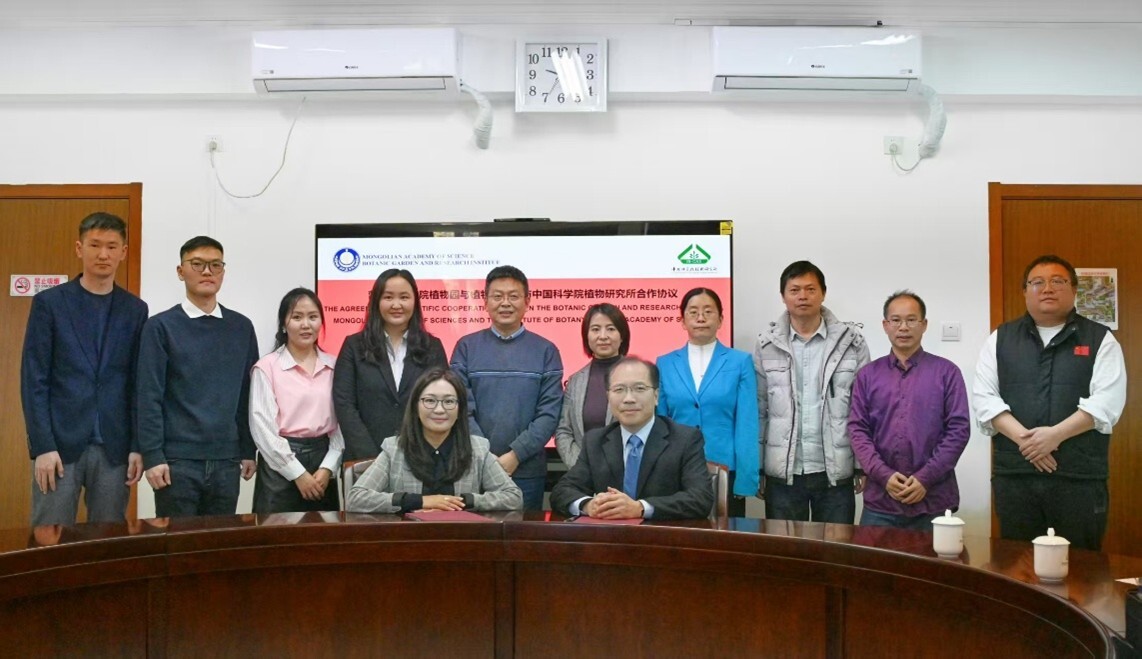
Group photo
On 27 November, a delegation led by Prof. Tuvshintogtokh Indree, the Director of the Botanic Garden and Research Institute of the Mongolian Academy of Sciences (BGRI-MAS), visited the Institute of Botany, Chinese Academy of Sciences (IBCAS). The two sides held in-depth discussions on global climate change, plant community dynamics of the Mongolia steppe, and the ecological restoration of degraded grasslands. During the visit, IBCAS and BGRI-MAS renewed the cooperation agreement. Prof. YANG Yongfeng, the Secretary of the Party Committee of IBCAS, together with relevant staff from IBCAS participated in the exchange activity.
Prof. YANG Yongfeng welcomed the visit of the Mongolian delegation and introduced the basic situation and research directions of IBCAS. He also briefly reviewed the history of collaboration between IBCAS and BGRI-MAS. He expressed the hope that both sides will further deepen the mutual trust and broaden the cooperation in the future, and actively address the ecological and environmental issues faced by the grassland ecosystems in China and Mongolia.
Prof. Tuvshintogtokh Indree presented an overview of BGRI-MAS and its cooperation history with IBCAS. The research fields of BGRI-MAS include plant diversity and conservation, environmental restoration and reforestation, climate change and ecosystem. They have established multiple long-term ecological research stations across different ecosystems of Mongolia, and have carried out extensive collaborative research with several countries, such as China, Russia, the Czech Republic and Germany.
Prof. HUANG Zhenying gave a comprehensive overview of the sustained and deepening cooperation between China and Mongolia in grassland ecosystem research. Since 2009, IBCAS has successively established three long-term field platforms for nitrogen and water addition experiments in Mongolia’s meadow, typical, and desert steppes, amassing 16 consecutive years of observation data. Throughout this period, the two sides have maintained frequent visits and exchanges, and achieved fruitful cooperation results in areas such as talent cultivation, joint project application, and co-publication of fingdings.
Prof. YANG Yongfeng and Prof. Tuvshintogtokh Indree signed the cooperation agreement on behalf of their respective institutions. The two sides agreed to intensify visits and exchanges, co-organize international conferences, jointly apply for research projects, and establish joint laboratories.
This visit has laid a solid foundation for future collaboration. Both sides will strengthen cooperation on the responses and adaptations of grassland plant communities to global changes, grassland restoration and desertification prevention, the construction of joint laboratories, and talent cultivation, aiming to jointly contribute to the restoration and sustainable development of grassland ecosystems in the context of global environmental changes.
Prof. YANG Yongfeng and Prof. Tuvshintogtokh Indree signed the cooperation agreement on behalf of their respective institutions
Group photo